Table of Contents
Key takeaways:
- Diagonal cutting pliers and side cutters often refer to the same basic category of wire-cutting hand tool.
- Regional terminology creates much of the confusion: “side cutters,” “diagonal cutters,” and “diagonal pliers” may describe very similar tools.
- The more important differences are cutting-edge geometry, jaw profile, leverage, cutter size, material capacity, and intended application.
- Flush, semi-flush, and conventional cutting edges can produce different wire-end finishes.
- Diagonal cutting pliers are primarily designed for cutting rather than gripping, tightening, or turning components.
- Tool selection should be based on wire material, diameter, working clearance, cutting frequency, and required finish.
- YINGSHIKE offers several plier and wire-cutting configurations that can support electrical, workshop, maintenance, and general tool applications.
If you search for diagonal cutting pliers, side cutters, diagonal wire cutters, or side cutting pliers, you may find tools that look almost identical.
That is not a coincidence.
According to the reference definition for diagonal pliers, the tool is specifically intended for cutting wire or small stock rather than gripping or turning. The same tool is commonly called a side cutter, snip, nipper, or diagonal cutter in different English-speaking regions.
This means the question “diagonal cutting pliers vs side cutters” does not always describe two completely different tools.
For professional selection, the better question is:
What cutting geometry, leverage, jaw shape, size, and material capability does the job actually require?
Are Diagonal Cutting Pliers and Side Cutters the Same?
In many tool catalogs and everyday applications, diagonal cutting pliers and side cutters describe the same general tool design.
The tool has two handles joined at a pivot, with cutting edges positioned toward the side of the jaws. Unlike combination pliers, the front of the jaws is primarily designed to cut rather than grip.
The cutting edges meet at an angle relative to the pivot, which explains the term “diagonal.” Wikipedia also notes that regional terminology varies considerably, with “side cutters” commonly used in the UK, Ireland, Canada, Australia, and New Zealand.
However, two tools carrying these names may still perform differently.
The differences usually come from engineering details rather than terminology.
Cutting Edge Geometry
One diagonal cutting plier may leave a pronounced wedge-shaped wire end, while another may be designed for a flatter finish.
Leverage
A high-leverage cutter positions the pivot and cutting edges to increase mechanical advantage, helping reduce the handle force required for tougher cutting work.
Jaw Profile
Compact tapered heads can reach restricted locations more easily, while broader heads may prioritize strength and durability.
Material Capability
Cutting soft copper wire is very different from cutting harder steel wire.
A tool should always be matched to the wire material and diameter specified for its cutting edges.
Diagonal Cutting Pliers vs Side Cutting Pliers Comparison
The terminology alone should not determine tool selection.
Compare the actual design instead.
| Feature | Standard Diagonal Cutting Pliers | Side Cutting Pliers / Side Cutters | High-Leverage Cutter | Flush Cutter |
|---|---|---|---|---|
| Primary function | Wire cutting | Wire cutting | Higher-force wire cutting | Precision trimming |
| Typical jaw | Angled cutting jaws | Angled side cutting jaws | Reinforced cutting head | Fine, narrow cutting head |
| Cut finish | Standard wedge cut | Standard wedge cut | Standard/heavier cut | Flatter finish |
| Leverage | Medium | Medium | High | Lower to medium |
| Best environment | General electrical/workshop | General electrical/workshop | Repetitive or tougher cutting | Electronics/fine assembly |
| Access to tight areas | Good | Good | Depends on head size | Very good |
| Main selection factor | Wire size and material | Wire size and material | Required cutting force | Finished cut quality |
The practical conclusion is that “diagonal cutter” and “side cutter” should not automatically be treated as different product categories.
Instead, compare specifications such as cutter length, jaw width, steel type, edge hardness, handle span, cutting capacity, and application.
For a broader overview of these tool families, YINGSHIKE’s existing article Pliers and Wire Cutters Types: Complete Guide to Selection, Applications & Professional Tool Comparison explains how diagonal cutters fit alongside combination pliers, needle-nose pliers, end cutters, and heavier cutting tools.
How Do Diagonal Cutting Pliers Cut Wire?
Diagonal cutting pliers do not work exactly like scissors.
Their hardened cutting edges indent and wedge the material apart as the handles close. The angled jaws concentrate force into a relatively small cutting area.
Three design elements strongly influence the result.
Pivot Position
The pivot acts as the fulcrum.
Moving the cutting area closer to the pivot generally allows greater mechanical advantage than cutting farther away.
This is why many cutters place their strongest cutting section close to the joint.
Handle Length
Longer handles can provide additional leverage, but they also increase the physical size of the tool.
A compact cutter may therefore be preferable in cabinets, control panels, assemblies, and other restricted spaces.
Cutting Edge Shape
The edge geometry determines how force enters the material and what the cut end looks like.
This becomes particularly important in electronics, wiring harness work, cable preparation, and fine assembly.
Flush Cut vs Standard Diagonal Cut
One of the most useful distinctions within diagonal cutting pliers is not “diagonal vs side.”
It is the style of cutting edge.
Standard Cut
A conventional diagonal cutter typically has beveled edges on both sides.
This creates a strong cutting edge suitable for general wire work, although the cut wire end may not be perfectly flat.
Semi-Flush Cut
A semi-flush design provides a compromise between edge durability and a flatter finished cut.
It can be useful where finish quality matters but the tool still needs reasonable durability.
Flush Cut
Flush-cutting pliers are ground differently so that one side can trim wire close to a surface or connection.
Wikipedia specifically identifies flush cutters as a variation commonly used in electronics work where wire needs to be trimmed close to a solder joint.
A finer flush edge should not automatically be considered “better.”
For heavier or harder wire, a more robust cutting geometry may provide better durability.
What Materials Can Diagonal Cutting Pliers Cut?
The answer depends on the individual tool.
Common applications may include:
- copper wire
- aluminum wire
- electrical conductor
- small steel wire
- cable ties
- component leads
- thin metal pins
- small plastic components
But the maximum cutting capacity can vary significantly.
A cutter designed for soft copper wire should not automatically be used on hardened steel.
Wikipedia notes that diagonal pliers can be used on materials including copper, brass, iron, aluminum, and steel wire, while also warning that cutters not designed for hardened material can suffer jaw damage when used on materials such as hardened piano wire.
This is one reason professional tool selection must go beyond appearance.
Diagonal Cutting Pliers vs Wire Cutters
Another common source of confusion is the relationship between diagonal cutting pliers and wire cutters.
“Wire cutter” is a broad functional term.
Diagonal pliers are one form of wire-cutting tool, but not every wire cutter has diagonal jaws.
Other designs may include:
- cable cutters
- end cutters
- flush cutters
- stripping and cutting pliers
- heavy-duty cutters
- bolt cutters
Different geometries are optimized for different materials and cutting conditions.
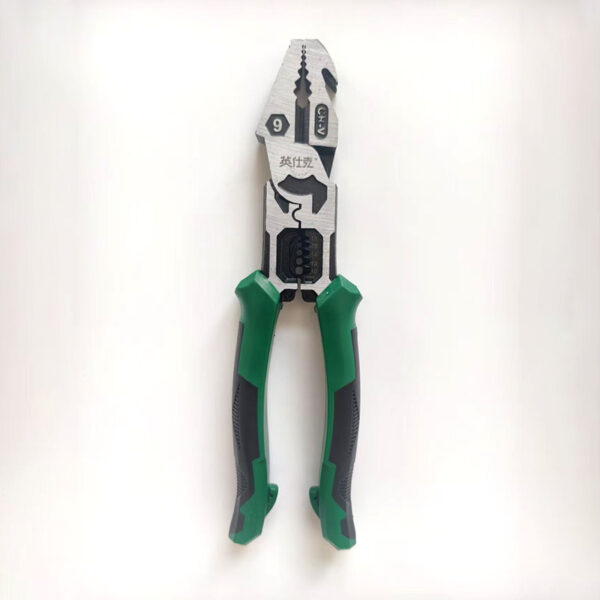
YINGSHIKE’s Wire Cutters combine cutting with multiple wire stripping and crimping functions, illustrating how a wire-working tool can be designed around several operations rather than diagonal cutting alone.
If you want a broader buying-oriented comparison, the existing YINGSHIKE article Best Wire Cutters Buying Tips expands the topic into different wire-cutting requirements and tool-selection considerations.
Diagonal Cutting Pliers vs Needle Nose Pliers
These two tools often appear together in electrical and maintenance kits, but they serve different primary purposes.
| Feature | Diagonal Cutting Pliers | Needle Nose Pliers |
| Main purpose | Cutting | Gripping and positioning |
| Jaw shape | Short cutting jaws | Long tapered jaws |
| Tight-space access | Good | Excellent |
| Wire bending | Limited | Very good |
| Precision gripping | Limited | Excellent |
| Cutting efficiency | High | Secondary on models with cutters |
| Typical use | Wire trimming | Positioning, bending, holding |
Needle-nose pliers are particularly useful when components must be reached inside restricted assemblies.
Diagonal cutting pliers are more specialized for removing excess wire or cutting conductors.
For applications that require both tools, YINGSHIKE’s 3-Piece Pliers Set includes needle-nose pliers, diagonal pliers, and a multifunction wire stripping tool. The diagonal pliers in this set are listed at 180 mm, while the set is designed to cover gripping, cutting, stripping, and related wire-work tasks.
YINGSHIKE also has a dedicated Precision Needle Nose Pliers Buying Guide for applications where gripping precision and access are more important than primary cutting performance.
When Should You Choose Diagonal Cutting Pliers?
A dedicated diagonal cutter makes the most sense when cutting is the main operation.
Electrical Installation
Electrical work commonly requires conductor trimming, cable preparation, and removal of excess wire after positioning.
A compact cutting head can also help where terminal boxes or panels provide limited working clearance.
Automotive Wiring
Wiring harness installation and repair can involve repeated trimming of wires, ties, and other small components.
A cutter with good handle control is useful when working around connectors and existing harnesses.
Electronics Assembly
Smaller cutters can be used for trimming component leads and fine wires.
When the final projection must be minimal, a flush cutting design may be more appropriate than a conventional diagonal edge.
Workshop Maintenance
Diagonal cutting pliers are useful general workshop tools for small wire, ties, pins, and compatible materials.
However, they should not replace heavier cutters where the material exceeds their rated capability.
Construction and Installation
Side cutters are also commonly used during electrical installation and repair. OSHA identifies pliers, crimpers, and side cutters among hand tools used in electrical contractor installation and repair tasks.
How to Choose Diagonal Cutting Pliers
Instead of starting with brand or appearance, begin with the workpiece.
Step 1: Identify the Material
Ask what will actually be cut.
Soft copper conductors, aluminum, cable ties, ordinary wire, harder steel, and component leads do not place the same load on cutting edges.
Step 2: Check Wire Diameter
Larger diameter generally requires more cutting force.
Always compare the intended material and diameter against the tool’s rated capacity.
Step 3: Decide What Cut Finish You Need
If the wire end will be hidden, a normal diagonal cut may be sufficient.
If the cut must sit close to a circuit board or component, flush or semi-flush cutters may be more suitable.
Step 4: Evaluate Working Clearance
A large high-leverage cutter may deliver more force but can become difficult to position inside an electrical panel.
Smaller cutters sacrifice some leverage in exchange for access and precision.
Step 5: Consider Repetition
Cutting one conductor occasionally and making hundreds of cuts during assembly are very different workloads.
For repetitive use, handle geometry, return spring design, pivot smoothness, cutting-edge durability, and overall tool weight deserve more attention.
Why Handle Design Matters
Handle design is not simply cosmetic.
The Canadian Centre for Occupational Health and Safety recommends selecting pliers or wire cutters with a handle grip span of approximately 6–9 cm and advises keeping cutting edges sharp because dull edges require substantially more force.
OSHA similarly notes that tools such as pliers and cutters can create finger contact stress during repeated opening and that incorrectly sized tools may require greater force and contribute to overexertion risk.
For frequent professional use, therefore, consider:
- grip width
- non-slip surface
- handle shape
- opening resistance
- return spring
- tool balance
- cutting force
- working posture
These elements can matter just as much as the appearance of the cutting head.
Choosing a Pliers Set Instead of One Tool
A single diagonal cutter is appropriate when the task is highly specialized.
For maintenance and electrical work involving several operations, a pliers set may provide more flexibility.
YINGSHIKE’s Multi-Function Electrician Pliers Set includes interchangeable heads for operations including wire stripping, needle-nose gripping, and diagonal cutting. The listed construction uses chrome-vanadium steel and a non-slip handle.
The 3-Piece Pliers Set takes a different approach by providing separate needle-nose, diagonal, and wire-working tools.
This gives users two different tool-system strategies:
| Tool Strategy | Main Advantage | Best Fit |
| Dedicated diagonal cutter | Direct access and simple operation | Repetitive cutting |
| 3-piece pliers set | Separate tools optimized for different jobs | Electrical and maintenance kits |
| Interchangeable pliers system | Multiple functions in compact format | Portable multi-function use |
| Multi-function wire cutter | Cutting, stripping and crimping combined | Wiring work |
The right approach depends on how frequently each function is used.
Common Mistakes When Using Side Cutters
Cutting Material That Is Too Hard
Hard wire can damage cutting edges that were designed only for softer materials.
Check the cutter specification before attempting hardened wire.
Cutting Too Far From the Pivot
When the cutter design allows it, thicker material is generally easier to cut near the stronger part of the jaws closer to the pivot.
Trying to cut demanding material at the tip can reduce available leverage.
Twisting During the Cut
Diagonal cutting pliers are designed to apply force through their cutting edges.
Using them as a twisting, prying, or levering tool can put loads on the jaws that the cutter was not designed to handle.
Using Dull Cutting Edges
Dull cutting edges require greater force and reduce control.
CCOHS recommends ensuring that cutting edges are sharp and using tools only when they are in good condition.
Assuming Handle Coating Means Electrical Insulation
A comfortable plastic or rubber-coated handle should not automatically be treated as certified electrical insulation.
Electrical work involving energized circuits requires tools specifically rated and certified for the applicable electrical environment.
How to Maintain Diagonal Cutting Pliers
Good maintenance helps preserve cutting performance.
Clean the Jaws
Remove wire fragments, dirt, grease, and other debris from around the cutting edges and pivot.
Inspect the Cutting Edge
Look for chips, dents, flattening, misalignment, or visible deformation.
CCOHS recommends inspecting hand tools for defects and replacing worn jaws on pliers and other tools where necessary.
Maintain the Pivot
The pivot should move smoothly without excessive looseness.
Follow the tool manufacturer’s maintenance recommendations regarding cleaning or lubrication.
Store the Tool Dry
Moisture and corrosive environments can affect steel surfaces.
A clean and dry storage area helps reduce unnecessary corrosion.
For more detailed operating advice, YINGSHIKE already has a dedicated article, 7 Must-Know Tips for Side Cutting Pliers. This article can be used as the next step for readers who understand the terminology but want practical usage tips.
Where Diagonal Cutting Pliers Fit in a Professional Tool System
Professional tool selection is usually based on operations rather than individual product names.
A typical electrical or maintenance workflow may require:
- diagonal cutting pliers for trimming wire
- needle-nose pliers for positioning components
- wire strippers for removing insulation
- crimping tools for terminal preparation
- screwdrivers for electrical enclosures
- wrenches or socket tools for mechanical fasteners
YINGSHIKE groups many of these configurations within its Multi Function Pliers category and broader Hardware Products range.
This is also an important selection principle: a multifunction tool can reduce the number of tools carried, while dedicated tools may offer better efficiency when one operation is repeated frequently.
Neither approach is automatically correct for every job.
FAQ
Are diagonal cutting pliers the same as side cutters?
In many regions, yes. “Diagonal cutting pliers,” “diagonal cutters,” and “side cutters” often describe the same general wire-cutting tool. The more useful comparison is the actual cutting-edge geometry, leverage, head size, material rating, and cut finish rather than relying only on the product name.
What are diagonal cutting pliers mainly used for?
Diagonal cutting pliers are mainly used to cut compatible wire and small stock. Common applications include electrical installation, wiring harness work, maintenance, electronics assembly, cable-tie trimming, and workshop tasks. Always confirm the tool’s cutting capacity before using it on harder or thicker wire.
Can diagonal pliers cut steel wire?
Some diagonal cutters can cut certain steel wires, while others are intended primarily for softer copper or aluminum. Hardened steel can damage an unsuitable cutting edge. Check the manufacturer’s material and diameter rating rather than assuming that every diagonal cutting plier can handle the same wire.
What is the difference between diagonal pliers and needle-nose pliers?
Diagonal pliers prioritize cutting, with short angled cutting jaws that concentrate force on wire. Needle-nose pliers use long tapered jaws for gripping, bending, positioning, and accessing restricted areas. Some needle-nose models include cutters, but cutting is normally not their primary structural function.
Should I choose flush cutters or standard diagonal cutters?
Choose based on the required finish and material. Flush cutters are useful when wire must be trimmed close to a component or surface, especially in fine electronic work. Conventional diagonal cutting pliers generally provide a more robust edge for everyday wire cutting and may be better suited to broader workshop use.
Final Thoughts
The difference between diagonal cutting pliers and side cutters is often smaller than the terminology suggests.
In many markets, the two names refer to essentially the same category of wire-cutting pliers.
What matters much more is the engineering behind the tool:
cutting-edge profile, leverage, jaw size, steel treatment, cutting capacity, handle design, working clearance, and intended material.
For general electrical and workshop use, standard diagonal cutting pliers provide a practical balance of control, durability, and cutting force.
For fine electronics, a flush-cut design may be more appropriate.
For harder materials or repeated cutting, a high-leverage design may provide better mechanical efficiency.
And where work involves cutting, gripping, stripping, and positioning, a multi-tool configuration such as the YINGSHIKE 3-Piece Pliers Set or Multi-Function Electrician Pliers Set can provide a broader working system.
Readers comparing multiple plier categories can continue with Pliers and Wire Cutters Types, while users looking specifically for practical cutter handling can read 7 Must-Know Tips for Side Cutting Pliers.