Choosing the correct wrench is essential for protecting fasteners, applying torque efficiently, and improving assembly speed. Although several tools can turn a six-sided fastener, their working mechanisms and suitable applications are different.
Key points covered in this guide:
- The difference between external hex bolts and internal hex socket bolts
- Common hexagonal bolt wrench types and their uses
- Open-end, box-end, combination, socket, adjustable, and hex key comparisons
- Metric and SAE sizing considerations
- Materials and finishes used in professional wrenches
- Practical selection advice for workshops and bulk buyers
- Common questions about torque, access, safety, and maintenance
Table of Contents
What Is a Hexagonal Bolt Wrench?
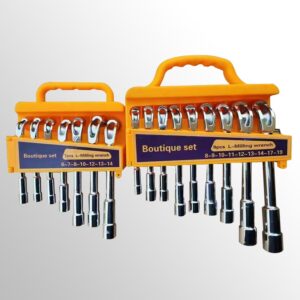
A hexagonal bolt wrench is a hand tool designed to grip and rotate a six-sided bolt, nut, or socket fastener. The six contact areas help transfer turning force while reducing unwanted movement when the tool and fastener are correctly matched.
The term can describe tools for two different fastener designs: external hex-head bolts and internal hex-socket bolts. Identifying the fastener type is therefore the first step in selecting the right wrench.
External Hex-Head Fasteners
An external hex-head bolt has six flat surfaces around the outside of its head. Open-end, box-end, combination, socket, and adjustable wrenches are commonly used with this design.
These fasteners are widely found in machinery, vehicles, steel structures, pipelines, and construction equipment.
Internal Hex-Socket Fasteners
An internal hex bolt or screw has a six-sided recess inside its head. It requires a hex key, hex bit, T-handle, or hex-bit socket rather than a conventional open-end wrench.
Internal hex fasteners are frequently used where a compact head, clean appearance, or recessed installation is required. Readers who need help matching these tools can consult this hexagon wrench size chart.
Main Hexagonal Bolt Wrench Types
Each wrench type offers a different balance of access, grip, speed, and torque. The best option depends on the fastener position, available working space, and required tightening force.
Open-End Wrench
An open-end wrench has a U-shaped jaw that contacts two opposite flats of an external hex fastener. Its open design allows the tool to approach a bolt from the side, which is useful around pipes, hoses, and long threaded rods.
The main advantage is quick placement. However, because it contacts fewer surfaces than a box-end wrench or socket, it is less suitable for heavily tightened or damaged bolts.
Best Applications
Open-end models work well for light assembly, plumbing connections, adjustment work, and fasteners with restricted top access. They are also useful when the wrench must be removed and repositioned frequently.
Box-End Wrench
A box-end wrench forms a closed ring around the bolt head or nut. Six-point versions closely match the shape of a hex fastener, while 12-point versions allow more engagement positions in confined areas.
A six-point box-end hexagonal bolt wrench generally provides better surface contact and a lower risk of rounding than an open-end design. It is a practical choice for higher-load fastening and removal work.
Six-Point vs. 12-Point Box Ends
A six-point opening offers strong engagement with a conventional hex bolt, making it suitable for higher torque. A 12-point opening is faster to reposition because it needs a smaller swing angle, but it may place more pressure near the fastener corners.
Combination Wrench
A combination wrench places an open end and a box end of the same size on one handle. The open end provides fast side access, while the box end offers more secure engagement for final tightening or initial loosening.
This dual-purpose structure makes it one of the most common choices for maintenance teams, mechanics, and portable tool kits. Buyers can explore different models in the YINGSHIKE professional wrench range.
Socket Wrench
A socket fits completely over the bolt head or nut and connects to a ratchet, breaker bar, extension, or torque wrench. It combines secure engagement with fast repetitive turning.
Sockets are particularly useful for automotive repair, equipment servicing, and production assembly. Deep sockets reach nuts on long studs, while extensions provide access to recessed fasteners.
Standard and Impact Sockets
Standard hand sockets are intended for manual ratchets and bars. Impact sockets are manufactured for use with impact tools and typically have thicker walls to withstand repeated shock loads.
Do not use a standard hand socket on an impact wrench unless the socket manufacturer specifically approves it for that application.
Adjustable Wrench
An adjustable wrench has a movable jaw that can fit several external hex fastener sizes. It is convenient for field service and general repairs where carrying a complete fixed-size set is impractical.
Its versatility comes with limitations. Incorrect jaw adjustment can cause slippage, damage bolt corners, or increase wear, so the movable jaw must fit closely against the fastener.
Hex Key or Allen-Style Wrench
A hex key engages the internal recess of a socket-head fastener. Traditional L-shaped versions provide a long arm for leverage and a short arm for access in confined areas.
Hex keys are compact and economical, but their size must match the socket precisely. ISO 2936:2014 specifies dimensions, testing, designation, marking, and minimum hardness requirements for hexagon socket screw keys.
T-Handle Hex Wrench
A T-handle model adds a crossbar or molded grip to the hex shaft. The design offers better control and faster rotation than a basic L-shaped key, especially during repeated bench assembly.
Its larger handle requires more storage and operating clearance. It is therefore best suited to workshops and production stations rather than compact mobile kits.
Ball-End Hex Wrench
A ball-end hexagonal bolt wrench has a rounded driving end that can engage an internal socket at an angle. This makes it useful when surrounding parts prevent straight-line access.
The reduced contact area means it should not normally be used for maximum final torque or for loosening a seized fastener. Start or finish high-load work with the straight end whenever possible.
Hex-Bit Socket
A hex-bit socket combines a male hex driver with a conventional square-drive socket body. It allows internal hex fasteners to be operated with ratchets, extensions, and calibrated torque wrenches.
This design is valuable in automotive, machinery, and industrial maintenance applications where controlled tightening and deep access are required.
Hexagonal Bolt Wrench Comparison Table
| Wrench type | Fastener design | Main advantage | Main limitation | Recommended use |
|---|---|---|---|---|
| Open-end wrench | External hex | Fast side access | Limited contact area | Light assembly and adjustments |
| Box-end wrench | External hex | Secure grip | Requires access over bolt head | Higher-torque manual work |
| Combination wrench | External hex | Two functions in one tool | Fixed to one size | General maintenance |
| Socket wrench | External hex | Fast and versatile | Requires sockets and drive tool | Automotive and machinery repair |
| Adjustable wrench | External hex | Fits several sizes | Greater risk of slipping | Field service and occasional use |
| L-shaped hex key | Internal hex | Compact and economical | Limited comfort during repeated work | Furniture and general assembly |
| T-handle hex wrench | Internal hex | Good control and speed | Needs more clearance | Workshop assembly |
| Ball-end hex wrench | Internal hex | Angled access | Lower torque capacity at ball end | Obstructed fasteners |
| Hex-bit socket | Internal hex | Ratchet and torque-wrench compatible | Bulkier than a hex key | Industrial servicing |
How Do I Choose the Right Hexagonal Bolt Wrench?

The decision should begin with the actual fastener rather than the appearance or price of the tool. Check the head design, size system, access conditions, torque requirement, and frequency of use.
Match the Fastener Profile
Use female openings, such as sockets or box ends, for external hex bolts. Use male drivers, such as hex keys and hex bits, for internal hex sockets.
A Torx fastener may also have six points, but its lobed profile is different. A conventional hex tool should not be used in a Torx recess.
Confirm Metric or SAE Size
Metric wrench sizes are expressed in millimeters, while SAE sizes are expressed in fractions of an inch. Some dimensions appear similar, but a near match may have enough clearance to slip under load.
Measure the fastener across two opposite flats and select the exact corresponding tool. Do not force an undersized wrench or compensate for an oversized one by tilting it.
Consider the Required Torque
For light adjustment, an open-end or adjustable model may be sufficient. For higher torque, a six-point box wrench or socket normally provides more complete engagement.
When a manufacturer specifies a tightening value, use a suitable torque wrench. A long handle can increase leverage, but it does not indicate the amount of torque being applied.
Evaluate Working Clearance
Side access favors an open-end wrench, while unrestricted top access allows a socket or box end. A ratcheting mechanism is useful where the handle has only a small movement range.
For internal hex fasteners positioned behind an obstruction, a ball-end model can improve access. It should still be used within the tool manufacturer’s angle and torque guidance.
Tool Material and Construction
Material alone does not determine performance. Steel grade, forging quality, heat treatment, dimensional accuracy, surface finish, and inspection all influence the service life of a hexagonal bolt wrench.
Chrome Vanadium Steel
Chrome vanadium steel is widely used in general-purpose hand wrenches. When correctly forged and heat-treated, it provides a useful combination of strength, toughness, and wear resistance.
A chrome-plated or polished finish can also make the tool easier to clean and more resistant to ordinary workshop corrosion.
Chrome Molybdenum Steel
Chrome molybdenum steel is commonly associated with impact sockets and other high-load tools. Its toughness can help the tool withstand repeated shock when the product is properly designed for impact use.
The alloy name should not replace verification of production standards, hardness control, and application rating.
Surface Finish
Polished chrome is easy to wipe clean, while satin finishes can reduce glare and improve handling with oily hands. Black oxide and phosphate finishes are frequently seen on impact-rated tools, although they still require protection from moisture.
Dimensional Accuracy
A precisely formed opening distributes force more effectively across the fastener flats. Loose tolerances increase movement and concentrate stress near the corners.
For metric wrench and socket openings, ISO 691:2005 addresses tolerances for tools used with across-flats dimensions.
Fixed Wrench vs. Adjustable Wrench
A fixed-size wrench is usually the better choice for repetitive professional work. Its opening is designed for one nominal fastener size, providing consistent fit and reducing adjustment time.
An adjustable model is more flexible when servicing unfamiliar equipment or carrying a limited field kit. However, it requires careful jaw adjustment before every use.
| Buying factor | Fixed-size wrench | Adjustable wrench |
|---|---|---|
| Fastener fit | More consistent | Depends on jaw adjustment |
| Size coverage | One or two sizes | Multiple sizes |
| Portability | Requires a set | One tool covers several sizes |
| High-load work | Generally preferable | Less suitable |
| Repetitive work | Faster and more reliable | Slower to reset |
| Emergency repairs | Limited if size is missing | Highly versatile |
Manual Wrench vs. Powered Hex Driver
Manual tools provide direct feedback and allow controlled positioning. They are well suited to final adjustments, delicate components, and applications where power tools would be difficult to control.
Powered drivers improve speed in repetitive assembly but can damage threads or recesses if the bit, torque setting, or alignment is incorrect. Final tightening should follow the equipment or fastener manufacturer’s specified procedure.
When Is a Manual Tool Better?
Choose a manual hexagonal bolt wrench when working near delicate surfaces, starting a fastener by hand, or dealing with low-torque components. Manual tools are also practical when power, air supply, or operating clearance is unavailable.
When Does a Socket System Make More Sense?
A socket system is better for repeated vehicle or machinery servicing, especially when extensions and ratchets are needed. YINGSHIKE’s professional automotive repair kits illustrate how sockets, handles, and related tools can be organized for varied maintenance tasks.
What Should Bulk Buyers Evaluate?

Distributors, workshop managers, and private-label buyers need to consider consistency across an entire shipment, not only the appearance of one sample.
Size Range and Set Composition
Review which metric or SAE sizes end users need most often. A carefully selected set can deliver more practical value than a larger set filled with rarely used sizes.
Also confirm whether the set needs short and long patterns, ball ends, ratcheting heads, deep sockets, or impact-rated components.
Testing and Quality Control
Ask suppliers how they inspect across-flats dimensions, hardness, torque resistance, surface quality, and markings. Test methods should be appropriate for the specific wrench category.
For professional orders, batch consistency and traceable specifications are more valuable than broad but unsupported performance claims.
Packaging and Storage
Tool rolls, racks, molded cases, and modular trays serve different sales channels. Retail packaging emphasizes presentation, while workshop cases prioritize fast identification and inventory control.
For broader storage planning, see this hardware tool box buying guide.
Common Selection Mistakes
Using an Approximate Size
A nearly fitting wrench may turn an unloaded fastener, but it can slip when resistance increases. Always use the exact metric or SAE size.
Applying Torque Through the Corners
Poor fit concentrates force on the corners of a bolt or socket recess. This can round the fastener and make future removal much more difficult.
Extending the Handle Improperly
Adding a pipe to a wrench handle can create force beyond the tool’s intended capacity. Use a properly rated breaker bar or torque tool instead.
Ignoring Worn Tools
A spread jaw, cracked socket, twisted hex key, or rounded drive end should be removed from service. OSHA states that wrenches with sprung jaws that can slip should not be used, and its hand-tool requirements emphasize keeping unsafe tools out of service.
Hexagonal Bolt Wrench Care and Safety
Clean oil, dirt, and metal particles from the tool after use. Dry it before storage and apply suitable corrosion protection to unplated surfaces when necessary.
Inspect contact areas regularly for deformation, cracks, excessive wear, or corrosion. Keep sets organized so users can identify the correct size without trial fitting.
Safe Operating Position
Seat the wrench fully on the fastener and keep the pulling force aligned with the handle. When practical, pull the wrench toward the body with a controlled motion rather than pushing with poor balance.
Correct Tool for the Job
Do not strike a standard wrench unless it is specifically designed as a striking wrench. Likewise, only use sockets and accessories rated for powered impact operation with an impact tool.
Conclusion
There is no single hexagonal bolt wrench type that is ideal for every task. Open-end models offer accessibility, box ends improve engagement, combination wrenches provide flexibility, and socket systems support fast, repetitive maintenance. For internal hex fasteners, L-shaped keys, T-handles, ball ends, and hex-bit sockets solve different access and torque requirements.
The best purchasing decision comes from matching the fastener profile, exact size, working clearance, and required torque. Professional buyers should also examine material processing, dimensional accuracy, testing, set composition, and packaging before comparing prices. A well-selected wrench protects fasteners, improves productivity, and delivers more reliable long-term value.
FAQ
What type of wrench is best for a hex bolt?
For an external hex bolt, a six-point box-end wrench or six-point socket offers strong engagement and is suitable for many higher-torque tasks. An open-end wrench is more convenient when only side access is available.
Is a hex wrench the same as an Allen wrench?
In everyday usage, “hex wrench,” “hex key,” and “Allen wrench” often describe the same tool for an internal hex socket. “Allen” originated as a trade name, while “hex key” is the more general product term.
Can I use an adjustable wrench on a hexagonal bolt?
Yes, provided the jaws are undamaged and adjusted tightly against the bolt flats. A fixed-size wrench or socket is usually preferable for repetitive or high-load work because it offers a more consistent fit.
Why does my hex wrench keep slipping?
The tool may be the wrong size, incompletely inserted, worn, or held at an angle. The fastener recess may also already be rounded or filled with dirt and debris.
Stop applying force and inspect both parts. Continuing after slippage can make the fastener much harder to remove.
Should I buy metric or SAE hexagonal bolt wrench sets?
Choose the system used on the equipment you service. Automotive, machinery, furniture, and imported products may use different standards, so a workshop handling varied equipment may need both clearly separated sets.
Is a ball-end hex wrench suitable for final tightening?
It is mainly intended for angled access and rapid positioning. For higher final torque, use the straight end fully inserted into the socket unless the tool manufacturer provides different instructions.
Which wrench is best for a rusted hex bolt?
A correctly sized six-point socket or box-end wrench is generally a better starting point than an open-end or adjustable tool. Clean the exposed surfaces and use an appropriate removal procedure without exceeding the tool’s rating.
How do I know whether a wrench is suitable for an impact tool?
Check the product marking and manufacturer’s documentation. Impact sockets are specifically designed and tested for powered impact loads; ordinary chrome hand sockets should not be assumed to be impact rated.
🔧 Let’s Stay Connected!
Thanks for reading — we’re glad you joined us on this journey through the world of professional hardware tools and innovative solutions!
Follow us on Facebook for exclusive insights, expert tips, and behind-the-scenes stories about our latest tool innovations, repair techniques, and product updates.
Let’s keep building, creating, and improving together.
Stay tuned for more guides, stories, and updates from our global tool community!